Bourbon & St. Philip
Three centuries,
by candlelight
The building has outlasted two empires, two great fires, and most of what was standing around it.
-
1722–1732
Nicolas Touze builds it
The structure goes up at the corner of Bourbon and St. Philip, built by Nicolas Touze. It is reputed to be the oldest structure used as a bar in the United States. In 1722, further building is recorded by a realty transfer set down by one Don Andres Almonester.
The structure and fence are in the old French Provincial Louis XV, or briquette-entre-poteaux, style used in French Louisiana — soft brick packed between heavy timber posts.
-
1772–1791
The brothers Lafitte
The property is believed to have been used by the Lafitte brothers, Jean and Pierre, as a New Orleans base for their Barataria smuggling operation.
The legend rests on who held the property. It was owned by the family of Simon Duroche, known as Castillon — a rather record-shy adventurer and entrepreneur — and by the wily privateer Captain Rene Beluche, who commanded his ship Spy in Lafitte's Baratarian fleet.
Although the owners of the property, Jean Baptiste Dominica Joly LaPorte, probably lived on the premises, it is within reason that the Lafittes could have used the place as a city base for negotiations with buyers. It is unlikely a wealthy Creole would agree to meet at home on Royal Street. Bourbon and St. Philip was probably regarded as safe and convenient neutral ground.
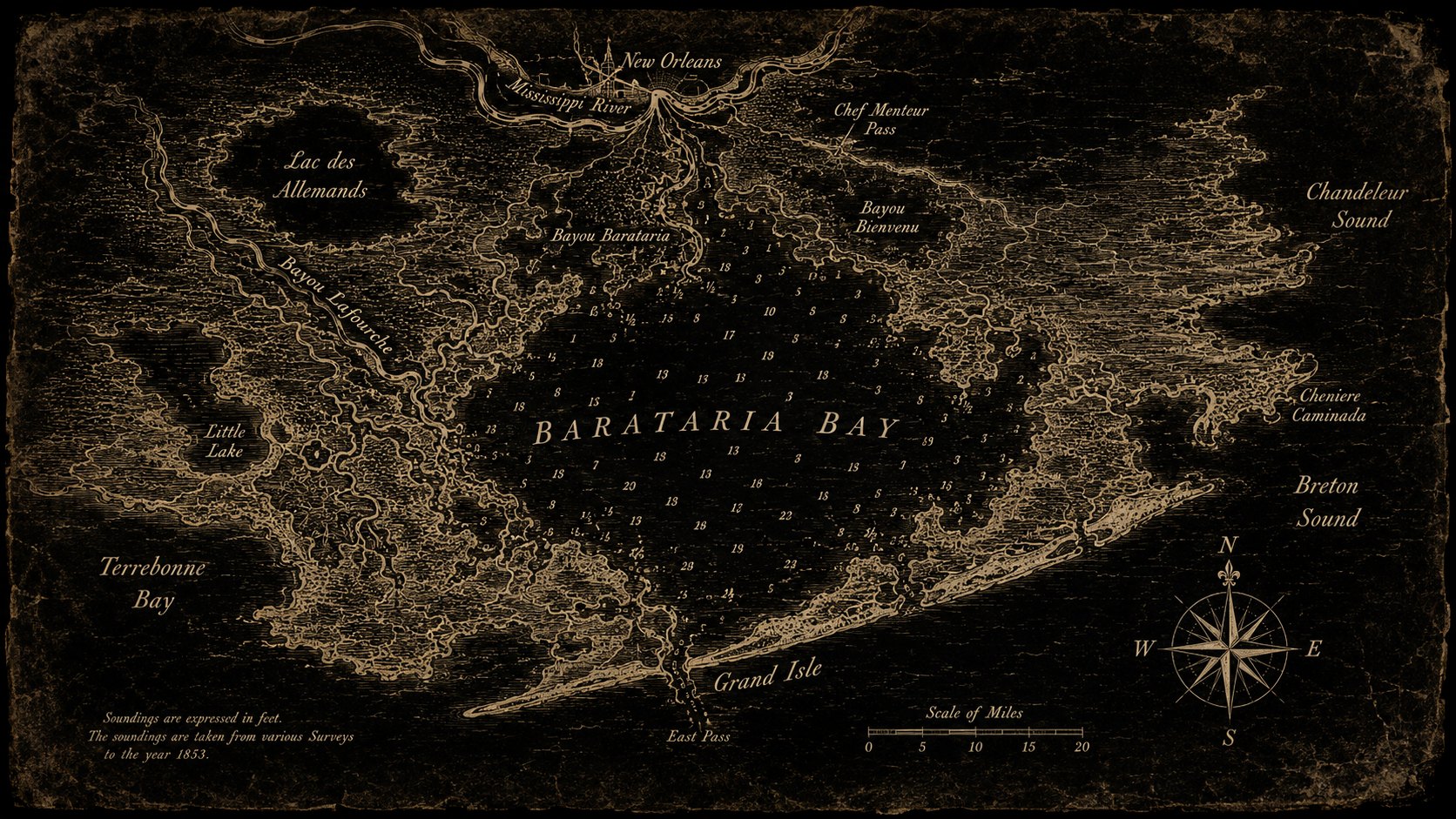
Barataria Bay and the water road north to the city. Goods came up the bayous; the corner of Bourbon and St. Philip was the end of the line. -
The fires
Turn of the 19th century
Two great fires sweep the Quarter. The building escapes both, owed to its slate roofing while the wood-shingled roofs around it caught.
Those same slates are used by artists as canvases today.
-
1814
Powder, flint, and troops
With the British at the mouth of the river, Lafitte rushes powder, flint, and troops to General Jackson at Chalmette.
Rather than a poorly supplied, out-manned force, the British stepped into a screaming hell of pirates, woodsmen, Indians and free people of color, under cover of a dense fog and an even more dense anti-British attitude. The British were routed.
His good deed done, the "hero" headed to sea and more familiar deeds.
-
1970
National Historic Landmark
The building is designated a National Historic Landmark, formal recognition for a structure whose own history had long been carried by word of mouth.
-
Tonight
Still open, still dark
No stage lighting, no renovation gloss. The room is lit the way it has always been lit, and the corners stay in shadow.
Like most New Orleans legends, Lafitte's Blacksmith Shop is a gumbo of truth and French, Spanish, African, Cajun and American embellishments.